

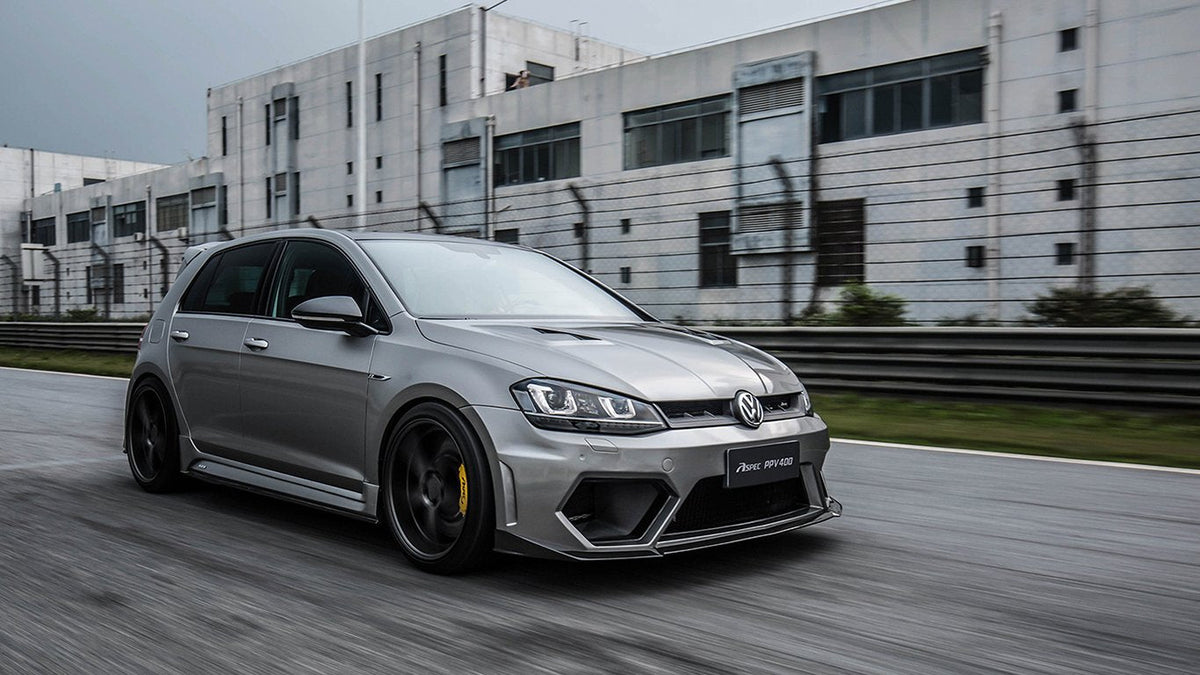
There's a moment in every Golf build where a lip spoiler and a set of weather shields stop feeling like enough. You start eyeing the cars at meets with the aggressive front bumper, the deep side skirts and the diffuser that ties the whole rear together — and you go looking for a full body kit. It's the single biggest visual change you can make to a MK5, MK6, MK7 or MK8 without touching the paint colour, and it's also the one most likely to go sideways if you rush it. So before you drop the deposit, here's the honest version of what a full body kit actually involves, what it really costs once it's on the car, and when you're better off building it piece by piece.
What a "full body kit" actually includes
The term gets thrown around loosely, and that's where a lot of buyers come unstuck. At one end you've got add-on kits — a front lip or splitter, side skirt extensions and a rear diffuser that bolt and bond onto your existing factory bumpers. At the other end you've got replacement kits, where the front and rear bumpers themselves are swapped for redesigned units, like the ASPEC Style Full Body Kit for the MK7 GTI and R. Add-on kits are cheaper, easier to reverse and lower risk. Replacement kits give you the biggest transformation but demand far more work to fit and finish. Neither is automatically "better" — they're different jobs at different budgets. The first thing to do is read the listing properly and know exactly which type you're buying and which panels are in the box.
The unpainted FRP reality
Most affordable kits — including a lot of what we stock — ship in FRP (fibreglass reinforced plastic), and they ship unpainted. That price tag on a full kit is the part, not the finished look on your car. Fibreglass is strong, holds its shape well and takes paint beautifully, but it almost always needs prep first: sanding, priming and sometimes a skim of filler on a high spot before a painter will colour-match it. Budget for paint as a real line item, not an afterthought. For a full kit you're realistically looking at several hundred to well over a thousand dollars at a good shop, depending on how many panels are involved and how fussy the colour is — Golf whites and the R's Lapiz Blue aren't always a quick match. The cars that look incredible wear their kit because someone paid to paint it properly. The ones that look cheap usually skipped that step.
Fitment: test-fit before you paint, every time
This is the rule that saves people the most heartache: mock the whole kit up on the car raw, before it goes anywhere near a paint booth. Aftermarket panels — fibreglass especially — can need trimming, drilling or a bit of gentle massaging to sit flush, and the panel gaps that are perfect on a factory bumper aren't guaranteed on a replacement one. A good installer will hang everything, check the gaps, sort the mounting, then pull it all back off for paint. Painting first and then discovering a skirt needs a few millimetres trimmed off the leading edge is how you end up with chips and stress cracks before the car's even back on the road. If you're not doing the fitting yourself, factor installer labour into the budget too — a full kit is not a Sunday-afternoon bolt-on.
Buying the whole kit vs building it piece by piece
A full kit in one box has genuine advantages: the pieces are designed to work together as a single look, you pay one lot of shipping, and you're not waiting months for a diffuser to match skirts you bought last season. But going piece by piece has its own logic. You can spread the cost, paint one panel at a time, and start with the highest-impact item — usually a front lip or a rear diffuser such as the Maxton Design MK7 R rear diffuser — before committing to the full transformation. If you're not 100% sure you want the aggressive full-bumper look, start with add-on pieces from the Golf MK7 range and live with them for a while. You can always go further later; it's a lot harder to walk back a set of replacement bumpers.
Will it pass rego here in Australia?
Worth being straight about this one. Body kits sit in a grey area with state roadworthy and defect rules, and the details vary between NSW, VIC, QLD, WA, SA and the rest. What inspectors tend to care about is sharp protruding edges, parts that sit lower than the regs allow or extend past the body outline, and anything that obscures your lights or number plates. A tasteful lip, skirt and diffuser kit that follows the factory body lines is rarely an issue; an extreme splitter that scrapes every driveway and speed hump is more likely to attract attention. Check your own state's rules before you buy, and if you're unsure, keep it sensible. We'd rather you enjoy the car than argue a defect notice.
Are full body kits worth it? The verdict
If you love the car and you're keeping it, a well-chosen, properly painted and correctly fitted body kit is one of the most satisfying things you can do to a Golf. It changes the whole stance and character in a way no single part can. It's worth it when you go in with your eyes open: buy the right kit for your bumper setup, budget for paint and fitting on top of the part, test-fit before paint, and keep it road-legal. It's not worth it if you're hoping the sticker price is the whole story, or you want a bolt-on-in-an-afternoon result. Rushed kits look rushed — that's exactly what gives aftermarket a bad name. Take your time and a good kit will look factory-plus, like the car left Wolfsburg wearing it.
Whatever you land on, we ship Australia-wide fast and we're always happy to talk through what's actually in a kit before you commit — that's the Dubhaus way. Measure twice, buy once.
Further Reading
Still weighing up materials and individual pieces? These two are worth a read next: Carbon Fibre vs ABS Plastic: Which Body Parts Are Worth Buying? and Maxton Design Splitters, Diffusers & Aero Kits: Are They Worth It?

Leave a comment
This site is protected by hCaptcha and the hCaptcha Privacy Policy and Terms of Service apply.